Thursday, 15 September 2016

Synthesis

This is what I think society at its best looks like. I used abstraction and modelling to visualize it as a character. This character is the vision of a Utopia. A divine machine; a divine system working in unity. It can only be achieved if everyone builds towards it. It will take time but if everyone is united, it is possible. 


Friday, 9 September 2016

Transdisciplinary Animation

Bonding

Atoms need stability. They do so by bonding with other atoms either of the same element or from different elements. Stability can be achieved by completing the outer shells of atoms. That involves either, giving, sharing or stealing electrons from other atoms. Certain elements act in a certain way when it comes to bonding. When a metal and a non metal bond, an ionic bonds is formed. When two non metals bond, a covalent bond is formed. When two metals bond, a metallic bond is formed.

I will mainly look at ionic and covalent bonding.

Ionic Bonds

Ionic bonding involves both sharing and stealing electrons. An atom shares an electron thus making it positively charged (cation)  and the other atom accepts the electron and this atom becomes negatively charged (anion). Electrostatic attraction occurs and an ionic bond forms. Electrostatic forces hold the atoms together. The resulting products are called salts.

Metals are the ones that give the electrons and non metals are the ones that receive electrons. Metals act this way because they have delocalized electrons in their outer shells which is an important feature in metallic bonding.

Columbo's Law states that the higher ions are charged, the stronger the bond. This could be measured through the number of valence electrons. Refer to the chart below.

The number of incomplete outer shells (one dot) determines the charge of non metals. 

Covalent Bonds

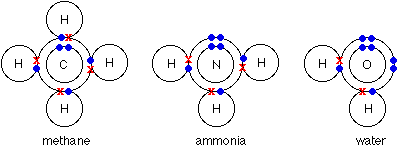
In covalent bonding, electrons are shared. No ions are involved because neither loses or gains an electron. This type of bonding can be found mostly between non metals. Covalent bonding stabilizes incomplete outer shells by sharing valence electrons to complete them (two dots). Depending on the number of free valence electrons, there could be single, double or triple bonds. 

Here is an example

Covalent bonds can be either polar or non polar. 

Non Polar covalent bonds occur when a covalent bond forms between two atoms that have the same electronegativity. 

Here is a chart for electronegativity

Polar covalent bonds occur when a covalent bond forms between two atoms that don't have the same electronegativity. Atoms with a higher amount of electronegativity pull the valence electrons of other atoms towards them. The resulting molecule is a dipole. This affects the shape of the resulting molecule. It also affects the polarity of the molecule. Water for example is a polar molecule because it has a slightly negative oxygen end and slightly positive hydrogen ends. This is so because oxygen is more electronegative than hydrogen which means the valence electrons pull towards it. Water being a polar molecule makes it a perfect solvent. The slightly positive poles attract negatively charged ions and the slightly negative pole attract positively charged ions. 

eg. NaCl (Table salt) dissolves in water because the anion part of it (Cl) is attracted to the positive ends of the water molecule (H) while the cation part of it (Na) is attracted to the negative end of water (O)

From this research, I think I've pin-pointed the key element for my transdisciplinary animation project; Valence electrons. Valence electrons can be transferred or shared, thus, it could represent the common elements between different genres. I could also use my previous research to show the different energy produced based on the union of two genres as an exothermic reaction; the resulting mood/tone shown visually through colours. Next step is to research about different genres and look at colour theory. 

References
http://www.shmoop.com/bonds-orbitals/bonding.html
http://www.shmoop.com/organic-chemistry/bonding.html
http://drjuanamendenhall.pbworks.com/f/Valence%2BElectron_0001.jpg
http://chem.libretexts.org/Core/Organic_Chemistry/Fundamentals/Ionic_and_Covalent_Bonds
http://www.chemguide.co.uk/atoms/bonding/ch4nh3h2o.GIF
http://users.stlcc.edu/gkrishnan/polar.html
http://chemed.chem.purdue.edu/genchem/topicreview/bp/ch8/graphics/fig8_8.gif
Level 2 Chemistry Learning Workbook - Alex Eames and Dorothy Kane Published by ESA


Tuesday, 6 September 2016

Loop

I made a loop from my segment of the class exquisite corpse animation.

Friday, 2 September 2016

Abstracting

The character I made for the abstracting exercise for my second discipline.


Transdisciplinary Animation

My second discipline for this project is Chemistry; chemical reactions in particular. I've been doing research about the different processes involved in chemical reactions. I'm mainly looking at the processes involved in chemical reactions.

There are 4 basic types of chemical reactions. These are synthesis, decomposition, displacement and redox.

Synthesis
- Or also known as combination reactions. Two reactants combine to form a new product. The reactants can be either elements or compounds. When two different elements combine, they form a compound. Two or more compounds can combine to form a new single compound. Bond forming is an exothermic reaction. Forming bonds takes less energy than breaking them, therefore energy is released making bond forming an exothermic reaction.

eg. A+B --> AB

Decomposition
- A compound breaks down into its component elements. A catalyst is needed in order to break the chemical bonds. Energy is absorbed when bonds break. Breaking bonds is an endothermic process. Energy is needed to break the chemical bonds holding together the component elements of the compound. Electrolysis is a method of decomposition that involves using electricity as a catalyst. Thermal decomposition involves using heat.

eg. AB --> A+B

Displacement
- There are two types of displacement reaction, single and double displacement reactions. In single displacement reactions, an element or compound is displaced and replaced by another element or compound in the single compound.  The reactivity of the elements involved determine the outcome.

eg. AB+C --> AC+B

In double displacement reactions, the elements are swapped with each other. Precipitates are often the results of this reaction.

eg. AB+CD --> AC+BD

Redox Reaction
- Reduction-Oxidation. This type of reaction involves the transfer of electrons. Oxidation is the loss of electrons while Reduction is the gain of electrons. These two take place simultaneously as one loses an electron, the other one gains it. Hence electron transfer.

Just doing this research has already given me a lot of ideas. I think that my idea is going along the lines of synthesis. Since I'm combining genres, a genre can be an element and when two or more genres combine, the resulting amalgamation will be a compound. Or maybe two genres can react like a redox reaction as a character(electron) is transferred, resulting into the character experiencing a new feeling/situation.

One thing that popped into my mind while doing this research is looking into the bonds formed in chemical reactions. Maybe two genres interlock like a covalent bond resulting into them sharing a story element kinda like a venn diagram. I'll look further into this research.

References

http://www.sparknotes.com/testprep/books/sat2/chemistry/chapter6section7.rhtml
http://www.shmoop.com/chemical-reactions/topics.html
Level 2 Chemistry Learning Workbook - Alex Eames and Dorothy Kane Published by ESA

Saturday, 27 August 2016

Friday, 26 August 2016

Group Project Concept

Story Genre: Dystopian Cyberpunk


The initial idea was Neon-Noir. Neon being the 80s cyberpunk dystopian world and Noir being the style of how the story is going to unfold.

The game will showcase a Cyberpunk narrative set in a dystopian future. It also features film noir elements. The noir elements will be present in the form of lighting, shots and tone to compliment the world that the game it is set in.

Cyberpunk and noir work together really well because cyberpunk narratives reflect the nuclear anxiety of the 60s-80s during the cold war. Nuclear anxiety caused social unrest during that time and this gave rise to neo noir narratives similar to how the post war and depression era gave rise to noir narratives.

Refrences include Robocop, Akira, Bladerunner, Cyber City Oedo 808, Snowpiercer

Story Theme/s: Capitalism, Greed, Corruption, Poverty, Crime, Mystery/Conspiracy, Hierarchy/Caste System, Utopia/Dystopia equilibrium

The themes that the story would be about will reflect in how the world looks rather than explicitly telling the state of the world through NPC interaction. They could exist as micro narrative elements that could tell something about the bigger world without explicitly showing/narrating the things that are going on. These could be clues in the form of posters, ads, or tv-screens.

The film Robocop (1987) did this really well through the satirical news and advertisements that provide exposition for the world that they live in. Often the news hint at the nuclear anxiety that the world is experiencing. The film itself just shows one aspect of the world which is a city in a state of unrest and plagued with crime to which the only solution was....Robocop!

Game Genre: Puzzle, Action

The game features a fictional alternative power source called "Neon" which is central to both the story and the mechanics of the game.

Why is Neon important?

After the war, people suffered the effects of nuclear fallout. But thanks to the advancement in technology, dysfunctional body parts can now be replaced by artificial ones. These artificial body parts have become a common commodity given the state of the world. But the only power source that can power these parts is Neon. Neon not only powers these parts but also reduces the rate of degeneration caused by radiation poisoning.

Neon was at first a radical solution. But the corrupt capitalists and government exploited this power source to keep themselves rich. But through the years, the effect of the fallout declined steadily. The corrupt government needed an alternative so that they could stay on top and keep on controlling the hierarchy of the society.

The level would take place in a shady storage where an alleged stolen crate of neon is being kept which turns out to be a black market den. This would be the level wherein the protagonist first encounters Noir. The protagonist will have to use Noir in order to progress and continue his investigation because some areas can only be accessed by using Noir. Neon and Noir will be used interchangeably to access different sections of this black market den.

Traps may exist in the form of traps set by the leader of the gang as he appears on the screen showing his control over the place. Or they could be environment traps animated as gang members hiding behind walls that the main character has to deactivate. Basically environment traps that are set to look like a shootout.

Setting: 80s vision of the future, New Lodz

New Lodz is a city divided into the upper and lower class. The game level will mostly feature the lower class portion of the city. It is a polluted and cramped space full of man made structures. Features of the well structured upper class areas can be seen throughout these areas to hint of what people hope to accomplish but it is but a hopeless dream in this tired world of theirs.


Aesthetic: Stylized
Music: 80s Synth

References include Kavinsky, Daft Punk, Noir Deco

Character Moodboard:


Style Moodboard: